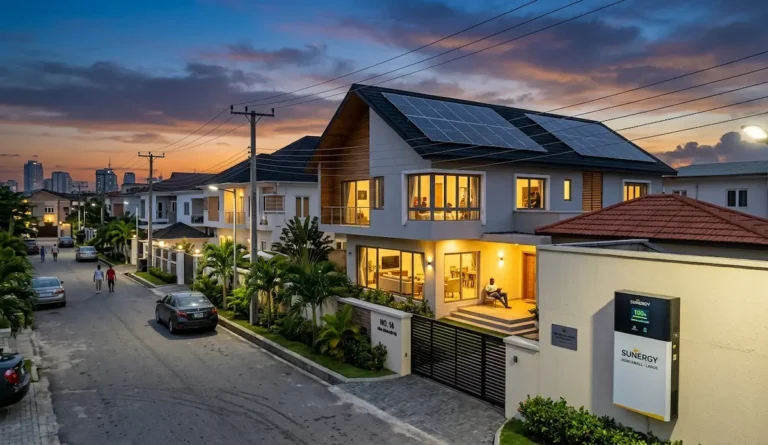
Across Africa, a brutal contradiction defines daily life. The continent holds the planet’s richest solar endowment — annual sunlight exceeding 2,500 hours across most regions, climbing past 3,000 hours in the Sahel, with a renewable potential well over 1,000 gigawatts. Yet the International Energy Agency still counts roughly 600 million people without stable electricity. Rural grids barely exist. Even city dwellers with a meter on the wall endure blackouts so routine they schedule work around them. Solar alone could never fix this.
The sun sets. Clouds roll in. But solar plus storage Africa is rewriting that equation. Batteries are turning an intermittent gift into a dispatchable, on-demand power source — and in doing so, they are fundamentally reshaping how African electricity markets work.
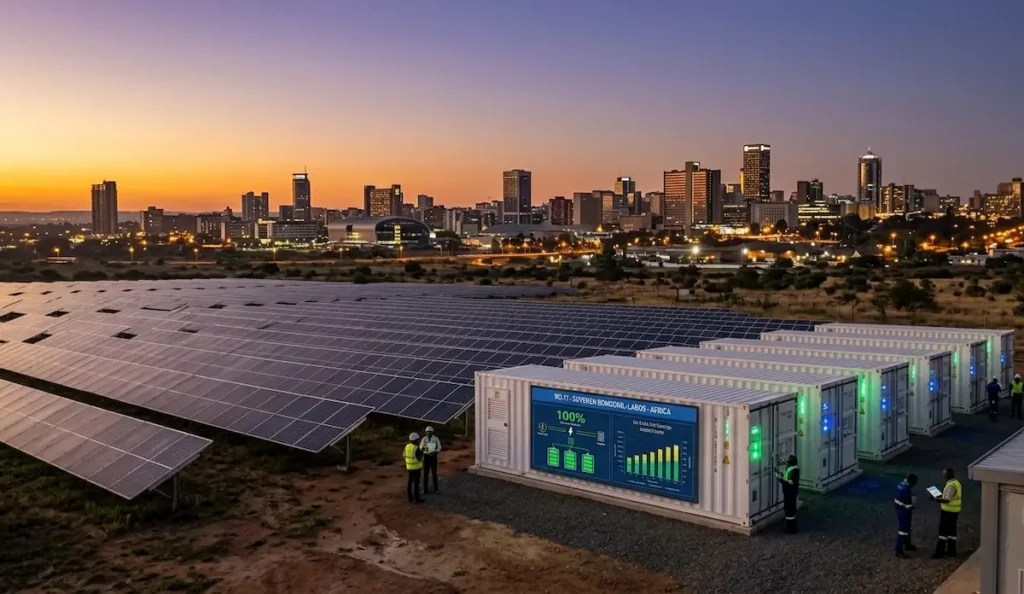
Why Solar Plus Storage Africa Is Becoming the Grid’s New Backbone
African power markets carry three structural vulnerabilities that solar plus storage Africa directly addresses: thin grid coverage, unreliable supply, and punishing costs.
Look at South Africa. In 2023, the country recorded 289 days of rolling blackouts. Households averaged eight hours without power per day. Nigeria, one of the continent’s largest economies, keeps the lights on for less than four hours daily in ordinary homes — and then hiked electricity tariffs by 231% in 2024. Factories, mines, cold-chain warehouses, and hospitals are not just paying high bills; they are losing output, spoiling inventory, and putting lives at risk every time the grid collapses.
For decades, the diesel generator filled the gap. It also locked users into volatile fuel prices and choking pollution. LCOE calculations now tell a different story. A solar plus storage system can deliver power at roughly $0.097/kWh — more than 70% cheaper than diesel generation. In Zambia, mining operations that switched to a “PV + battery + diesel” microgrid slashed energy costs by 60%. Some sites now run on over 95% green electricity. These numbers pull solar plus storage Africa out of the “nice-to-have sustainability” category and into hard-nosed balance-sheet decisions.
The real breakthrough, though, is dispatchability. A standalone solar farm produces electrons when the sun decides. Add battery storage, and the operator decides. Midday surplus gets banked. Evening peaks get served. The hybrid plant behaves more like a gas turbine than a weather-dependent array. For grid operators in Nairobi or Lusaka managing weak frequency and volatile loads, that behavioral shift is everything. It means solar can anchor a grid, not just feed into it.
From Gigawatt-Scale Plants to Streetlight Microgrids
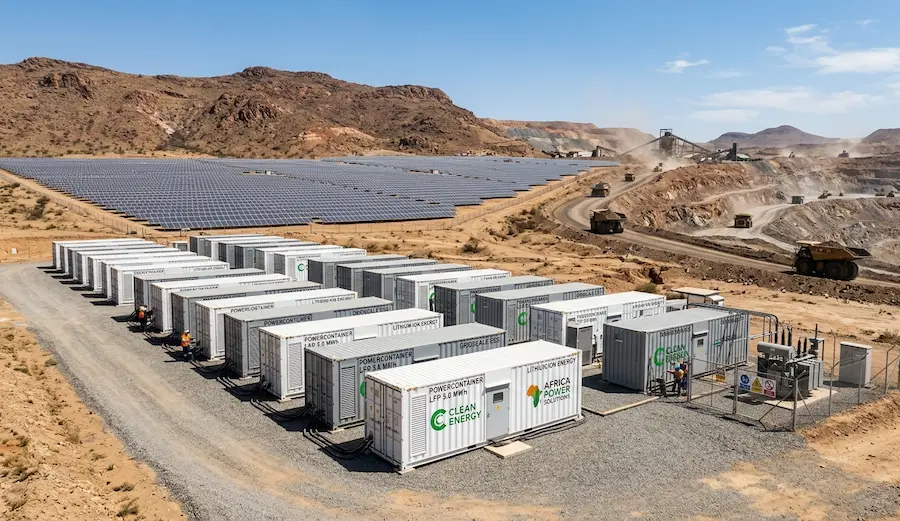
The deployment of solar plus storage Africa unfolds at every scale simultaneously. Utility-scale parks feed national grids. Rooftop batteries rescue factories. And in villages far from any transmission line, a streetlamp and a home battery are stitching together the smallest energy networks on the continent.
Utility-Scale Solar Plus Storage Africa: Dispatchable Power Enters the Grid
Massive integrated projects are becoming the backbone of national power planning. Consider the Oya Energy Hybrid Facility in South Africa — a $590 million project combining 561 MW of solar PV with 100 MW / 200 MWh of battery storage. Its first phase entered operation in February 2026. The technical specs are impressive, but what made the project bankable was its capital structure. Roughly 80% of funding came as non-recourse debt from the European Bank for Reconstruction and Development, the African Development Bank, and British International Investment.
A dual-shareholder structure kept the developer in control while bringing strategic equity partners to the table. All output is sold under a 25-year power purchase agreement backed by a sovereign guarantee. The battery dispatch schedule follows the PPA exactly — zero merchant risk, fully predictable revenue. This template — multilateral backing, long-term PPA, storage dispatched as baseload — is fast becoming the model for large-scale dispatchable renewable projects across Africa.
North Africa is moving even faster. Egypt is developing a 1 GW solar plus 600 MWh storage complex. Morocco’s Ouarzazate complex already operates one of the world’s largest thermal storage systems. Across the Middle East and North Africa, solar auction prices have crashed to $0.0109/kWh, and storage deployment is projected to expand sixfold by 2030. Grid-scale renewables are graduating from “supplementary power” to “baseload replacement.”
C&I and Mining Microgrids: Cutting Costs Where It Hurts
Away from the mega-projects, commercial and industrial users are driving some of the fastest adoption. Walk through Kenya’s tea-growing highlands or its flower-farm belt, and you will find “PV + battery” systems spreading across factory rooftops and field stations. These are not vanity installations. They run in peak-shaving and backup modes, slashing demand charges and keeping cold rooms humming when the utility line goes dead.
Across eastern Africa’s C&I market, the most compelling sales pitch is not the cents-per-kWh savings — it is avoided outage cost. A chocolate factory that loses a batch because the grid tripped at 2 a.m. does not care about levelized cost math. It cares about production insurance. That pain point makes the ROI conversation almost embarrassingly easy. Many industrial parks now layer energy management systems on top of the hardware, orchestrating solar generation, battery discharge, and even EV charger loads into a single optimized microgrid.
Off-Grid Homes and Community Microgrids: From Lighting to Livelihoods
Out where the grid simply never reached, off-grid solar plus storage Africa systems are undergoing a quiet generational leap. A basic solar home kit once powered a phone charger and two LED bulbs. A standard household system today — 11 kW of PV panels feeding a 51.2 V, 16 kWh lithium iron phosphate battery pack — runs televisions, refrigerators, small freezers, and water pumps. It can generate around 36.4 kWh on a typical day.
Platforms like Sun King and M-KOPA have built massive distribution networks by bundling hardware with mobile-money PAYGo financing. Millions of households now pay for electricity in daily installments the price of a cup of tea. But the real shift is toward productive-use energy: solar irrigation pumps, solar cold storage for fish and vegetables, small workshop tools. A battery is no longer just a light switch — it is a livelihood engine.
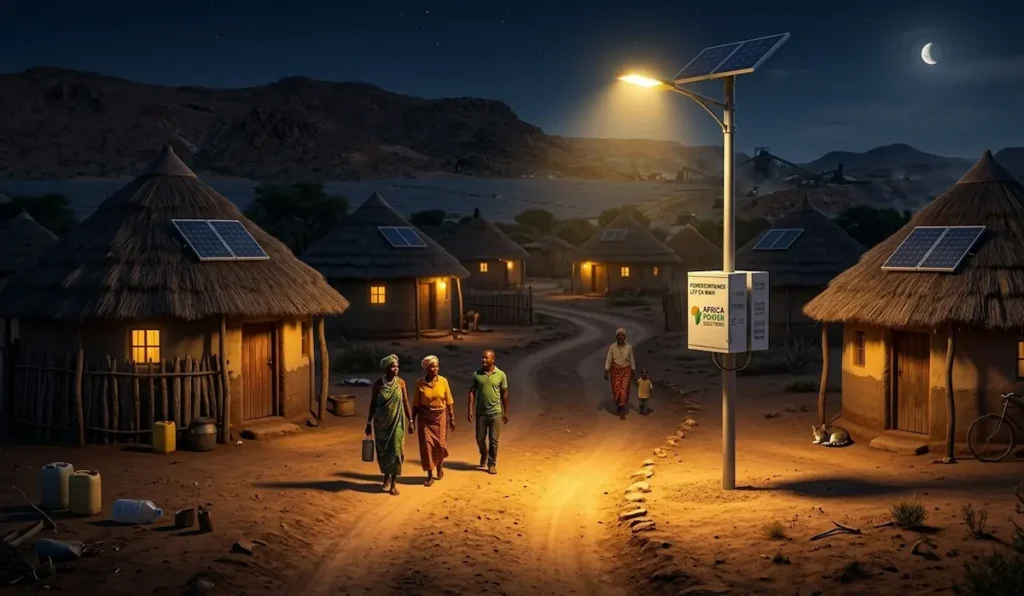
The most inventive deployment might be the streetlight-home-storage microgrids emerging in places like Mombasa, Kenya. Chinese firms have installed solar streetlights with integrated lithium batteries and MPPT controllers. During the day, excess charge spills over to nearby home storage units through smart controllers. At night, those household batteries can feed emergency power back to the streetlights. Pilot data shows the shared architecture lifts overall energy utilization by 40%. Some sites have shifted to centralized storage pools, replacing scattered batteries with a single lithium hub. System efficiency jumped 30%. Maintenance costs halved. Rainy-day autonomy stretched to four days. The streetlamp stopped being a lamp — it became the neighborhood power node.
Policy, Capital, and the Real Risks on the Ground
The solar plus storage Africa boom is not purely a technology story. Policy tailwinds and development finance have kicked the doors open. Kenya exempts dedicated solar equipment from import duties and VAT. South Africa’s REIPPPP program continues to award projects while the Electricity Regulation Amendment Act has unbundled the monopoly utility and created a competitive market. Rwanda and Uganda are carving out focused niches around off-grid and mini-grid deployment with tax incentives and concessional finance. The World Bank and African Development Bank have committed to connecting 300 million people by 2030 — roughly half of them through renewable mini-grids and standalone solar systems. That commitment provides a multi-decade demand signal for the storage supply chain.
But no one operating in these markets will describe them as smooth. Tariff policy wobbles. Within the East African Customs Union, tax exemptions for certain off-grid solar products have been partially rolled back, and customs classification disputes over batteries and balance-of-system components are routine. Currency risk hangs over every long-term contract. Revenue arrives in Kenyan shillings, Ugandan shillings, or Nigerian naira. Equipment invoices are in dollars. Over a 10-year project life, depreciation can erase margins that looked comfortable in a spreadsheet.
Then there is the gritty operational reality. Customer defaults in PAYGo portfolios. Spare parts that take weeks to arrive. Installations compromised by poor wiring or grounding. Compliance paperwork that stalls microgrid permits. The firms that survive and scale are not necessarily the ones with the cheapest hardware. They are the ones with precise HS-code planning for customs, assembly footprints inside special economic zones to lock in tax advantages, dollar-linked tariff adjustment clauses in PPAs, and in-country service teams that show up within 24 hours.
Where the Market Is Heading Next
Africa’s solar plus storage market is not just growing — it is structurally deepening. Lithium battery cycle life now exceeds 8,000 cycles. System costs keep grinding lower. Industry forecasts point toward a market surpassing $10 billion by 2030.
New demand drivers are accelerating the trajectory. Data centers are emerging across the continent, and they are becoming voracious clean-power buyers. An AI training cluster or a cloud region needs long-term, bankable, dispatchable electricity — exactly the product a well-structured solar plus storage plant delivers. Regional power pools like the Eastern Africa Power Pool are creating cross-border arbitrage opportunities: a battery park in Kenya can absorb cheap daytime solar and export firm power to a neighboring country during its evening peak.
Five years from now, the story will not be about replacing diesel generators. It will be about powering factories, trade corridors, and the digital infrastructure of a continent that skipped the copper-wire age and is building a distributed, dispatchable, clean grid from scratch.
The generators are getting quieter. The batteries are getting smarter. And across Africa, the next sunrise is already being saved for after dark.